If you’re researching wisdom tooth extraction, and especially sedation options, you’re already ahead of the curve. Wisdom teeth are one of the most commonly delayed procedures in dentistry, and waiting too long can lead to cysts, infections, jaw damage, and even full facial swelling.
But something most people don’t know is this: Where you choose to have your wisdom teeth removed matters just as much as whether you have them removed at all.
At ProSmile Dental Implant Center, wisdom tooth extraction isn’t treated as “just another dental procedure.” It’s a surgical experience handled exclusively by Board-Certified Oral & Maxillofacial Surgeons, supported by an in-house Dental Anesthesiologist, and completed in a center designed for complex surgery, not a routine dental clinic.
This guide will walk you step-by-step through:
- What IV sedation actually feels like
- What makes ProSmile different from a regular dentist’s office
- Why oral surgeons are the gold standard for wisdom teeth
- How we reduce the risk of complications like swelling and dry socket
- What your recovery will look like
- Real insights from ProSmile surgeons and our anesthesiologist
Let’s begin with the #1 question most patients have: Why does sedation/anesthesia matter for wisdom tooth extraction?
Ready for a calmer, safer dental Extraction?
Speak with our team and discover which level of sedation is right for your wisdom tooth removal surgery, all supervised by our in-house Dental Anesthesiologist and Board-Certified Oral Surgeons.
Why Sedation Matters for Wisdom Tooth Extraction
Wisdom teeth sit deep in the bone, often angled sideways, pressing into nerves or neighboring teeth. Removing them requires surgical precision, and complete patient comfort. That’s why most high-level surgical centers use IV sedation or general anesthesia, not just numbing injections.
At a regular dentist’s office:
- Sedation is usually limited to oral pills or nitrous oxide
- The dentist may not have surgical training
- Complex impactions may require referral
- Anesthesia is not tailored to your medical needs
At a Surgical Center like ProSmile:
- You’re sedated by a residency-trained Dental Anesthesiologist
- Your surgery is performed by a Board-Certified Oral Surgeon
- Anesthesia levels range from light sedation to full general anesthesia
- Your airway, breathing, and safety are continuously monitored
“Our anesthesia here at ProSmile ranges from light sedation to deep sedation and even general anesthesia. We offer you that service to alleviate fear, anxiety, and make it so you’re essentially not ‘here’ for the surgery.”
— Dr. Aaron Roberts, our in-house Dental Anesthesiologist
Oral Surgeon vs. General Dentist: Why It Matters for Wisdom Teeth
Most people assume all dentists can remove wisdom teeth, and technically, that’s true. But should they? According to Dr. Velangi:
“If I needed LASIK, I would only go to an ophthalmologist. The same way, with wisdom teeth, if you want it done right and with minimal complications, you should only go to an Oral Surgeon.”
Oral & Maxillofacial Surgeons complete:
- 4 years of dental school
- 4–6 additional years of hospital surgical residency
- Training in anesthesia, airway management, facial surgery, and medical emergencies
This is why Dr. Velangi says:
“We are Oral & Maxillofacial Surgeons who have gone through years of additional training to make this a risk-free and complication-free procedure.”
The ProSmile Advantage:
- Two full-time oral surgeons (Dr. Hosseini & Dr. Velangi)
- An in-house anesthesiologist (Dr. Roberts)
- Same-day or next-day complication coverage
- On-site advanced imaging
- An in-house lab for grafting materials and surgical planning
Surgical centers are built for complex cases; general dental offices are not.
Hidden Dangers of Not Removing Wisdom Teeth Early
Some wisdom teeth hurt, but most don’t. And that’s the danger. Dr. Velangi explains it perfectly:
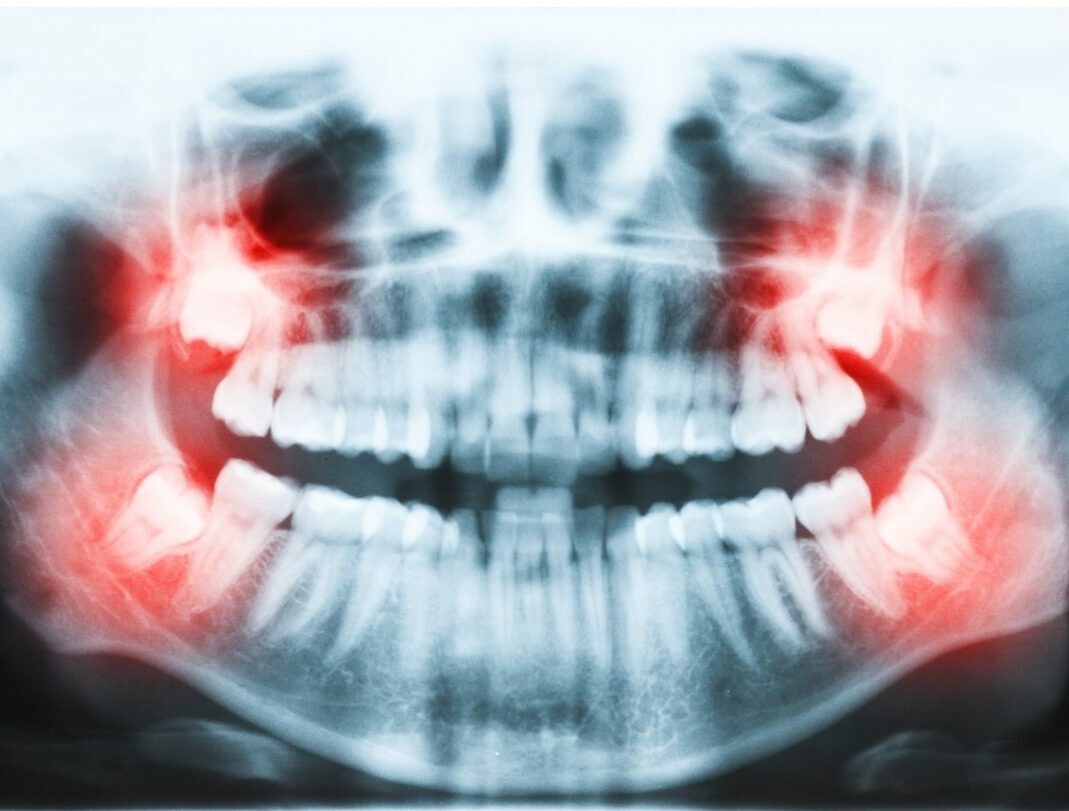
“Wisdom teeth can cause trouble silently. You won’t feel pain, but X-rays show cysts, wrong angulation, or decay forming on the tooth in front. By the time you feel it, it’s often too late.”
Examples of silent but serious issues:
- Cysts that hollow out the jaw
- Bone loss around the second molar
- Cavities caused by an impacted tooth
- Nerve compression
- Jaw fracture risk
Yes, your jaw can break. One of our recent patients learned this the hard way:
“This patient was told he didn’t need his wisdom teeth out as a teenager. Years later he had jaw pain and trouble opening. We found a large cyst that could have fractured his jaw.”
That patient required:
- Full sedation
- Extraction of all four wisdom teeth
- Cyst removal
- PRF bone grafting
Had it been caught earlier, it would’ve been a routine procedure.