
Wisdom teeth, also known as your third molars, are the last teeth to develop, and for most people, there simply isn’t enough room in the jaw to accommodate them. When they can’t come in properly, they can cause pain, infection, crowding, bone loss, and a range of other problems that tend to get worse over time if left unaddressed.
At ProSmile Dental Implant Center, wisdom teeth removal is performed by our board-certified oral surgeon, using advanced 3D imaging, in-house sedation, and a natural-healing protocol designed to minimize discomfort and speed recovery. Whether you’re experiencing symptoms now or simply haven’t had your wisdom teeth evaluated, our team is here to help!
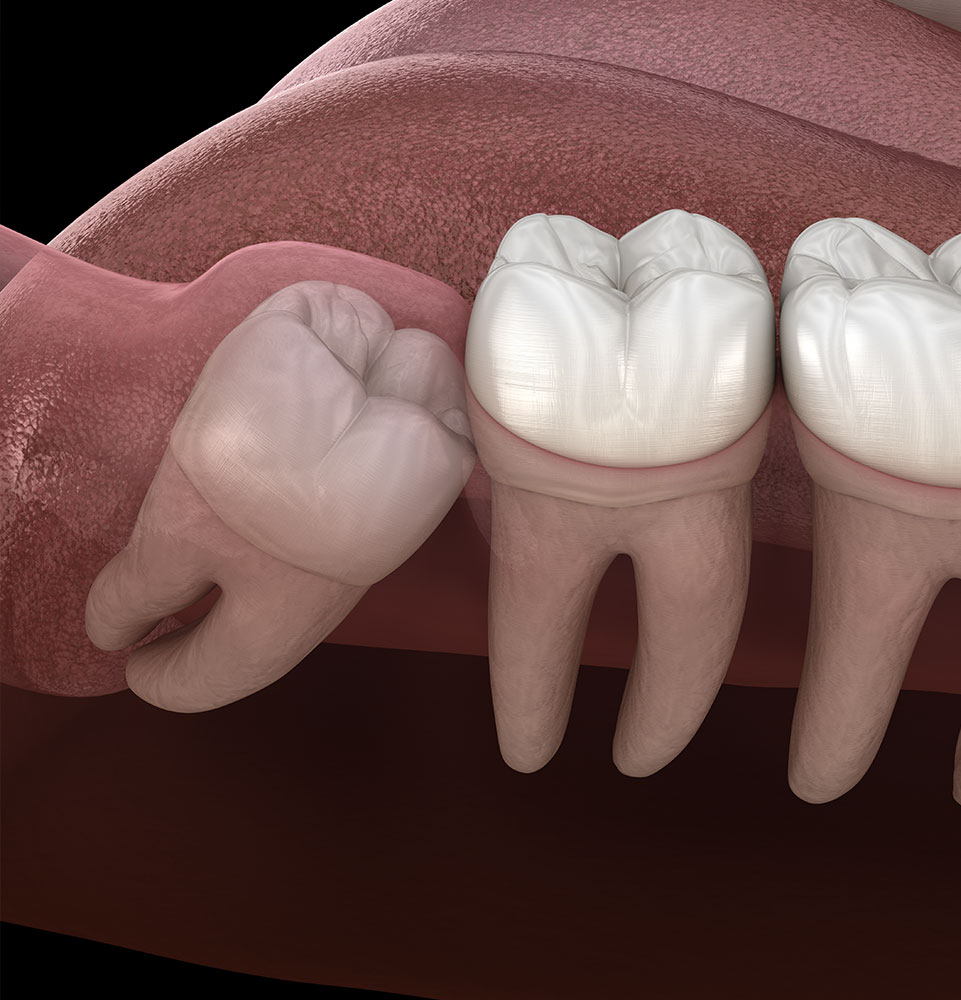
Wisdom teeth are the third set of molars located at the very back of the mouth, two on the upper jaw and two on the lower. They typically begin developing between the ages of 11 and 13 and attempt to erupt in the late teens to early twenties, by which point the rest of the adult teeth are already fully established. This leads to a range of complications:
Not everyone experiences dramatic wisdom teeth symptoms in Scottsdale and Phoenix, AZ, but there are several signs worth paying attention to. You may benefit from a wisdom tooth evaluation if you’re experiencing:
Aching, throbbing, or a persistent feeling of pressure at the back of the jaw, especially on one side, is one of the most common early signs of wisdom tooth eruption or impaction.
Gum tissue around a partially erupted wisdom tooth can become inflamed, swollen, and prone to bleeding. This is a sign that bacteria are accumulating in a difficult-to-clean area.
Inflammation around an erupting or impacted wisdom tooth can spread to the surrounding jaw muscles, causing stiffness, reduced range of motion, or discomfort when chewing.
When a wisdom tooth is impacted or inflamed, the associated pressure can radiate toward the ear or temple, causing persistent ear pain or headaches that may seem unrelated to your teeth.
A partially erupted wisdom tooth creates a pocket between the tooth and gum tissue where food, debris, and bacteria accumulate. This can cause a chronic bad taste or odor that doesn’t resolve with brushing.

Your evaluation begins with a complimentary consultation that includes a full CBCT 3D CT scan. Unlike a standard dental X-ray, this imaging technology provides our oral surgeon with a detailed, three-dimensional view of your wisdom teeth, the surrounding bone, and, critically, the exact location of the inferior alveolar nerve.
This level of detail is essential for safe, precise surgical planning and is included at no cost to you. Our oral surgeon reviews the scan with you during your appointment, explains exactly what’s happening with your wisdom teeth, and discusses the recommended course of action. There is no pressure and no obligation.
On the day of your procedure, our in-house anesthesiology team administers sedation so you remain completely comfortable and unaware throughout the surgery. We offer multiple sedation options and will discuss the appropriate level for your case and comfort level during your consultation. You won’t feel a thing, and most patients have little to no memory of the procedure itself.
Your extraction is performed by our board-certified oral surgeon, who has completed thousands of wisdom tooth cases, including complex impactions, multi-root extractions, and cases involving intimate proximity to the inferior alveolar nerve.
Having a surgeon of this experience level matters, both for your safety and for minimizing postoperative discomfort and complications. The procedure typically takes less than an hour, and you’ll have our surgical team with you from first incision to final suture.
One of the things that sets us apart is our use of platelet-rich fibrin, a natural healing material derived from a small sample of your own blood, processed chairside immediately before your procedure.
PRF is placed in the extraction sites to form a biologically active healing plug that accelerates tissue regeneration, reduces swelling, and significantly lowers the risk of dry socket, one of the most common and uncomfortable complications following wisdom tooth removal. This is natural healing technology sourced entirely from your own body, no synthetic materials required.
Most patients reach the worst of recovery within 3–5 days when post-operative instructions are closely followed. Our team provides thorough written aftercare instructions and is available by phone throughout your recovery to answer questions or address any concerns.
Swelling, light bleeding for the first 24–48 hours, and some jaw stiffness are all normal and expected. With rest, soft foods, and proper oral hygiene around the surgical sites, most patients return to normal activity within a week.
When it comes to wisdom tooth removal, especially in impacted cases or those involving proximity to critical nerves, your provider’s experience matters significantly. After dental school, a board-certified oral surgeon completes an additional four to six years of surgical residency, dedicated to procedures such as extractions, bone surgery, and anesthesia management, performing hundreds of wisdom tooth cases at every level of complexity along the way.
At ProSmile Dental Implant Center, our oral surgeon has completed over 10,000 successful wisdom tooth procedures, bringing a level of precision, safety, and complication management that general dentistry simply can’t replicate at that volume. Patients throughout Scottsdale and Phoenix, AZ, choose our practice because they want a specialist who performs this procedure every day, not a referral, not a second option, but expert surgical care from the start.
Wisdom teeth typically begin developing around ages 11–13 and attempt to erupt between the late teens and early twenties. This window, roughly 15–19 years of age, is generally considered the ideal time for removal.
At this stage, the roots are not yet fully formed, the surrounding bone is less dense, and recovery tends to be faster and less complicated than in older patients. That said, wisdom teeth can and should be evaluated and removed at any age when they are causing or are likely to cause problems.
Not always, but all wisdom teeth should be professionally evaluated. Some patients have wisdom teeth that erupt fully and are healthy enough to maintain with proper oral hygiene.
However, even symptom-free wisdom teeth can develop cysts, contribute to bone loss, or create conditions that will become problematic over time. A 3D imaging evaluation is the only reliable way to determine whether your wisdom teeth are safe to leave in place or should be removed.
The procedure itself is performed under sedation, so patients feel nothing during surgery. Postoperative discomfort is normal and typically peaks in the first 48–72 hours before improving steadily. Most patients describe the soreness as manageable with prescribed pain medication and rest.
Our use of platelet-rich fibrin at the extraction sites actively reduces swelling and speeds healing, which patients consistently report makes their recovery noticeably more comfortable than they expected.
Most patients experience the greatest discomfort in the first 3–5 days after surgery. Swelling peaks around day two or three, typically before gradually resolving. Light bleeding in the first 24–48 hours is normal. The majority of patients return to normal daily activities within a week, though complete tissue healing takes several weeks. Following your post-operative instructions carefully, particularly avoiding smoking, straws, and vigorous rinsing in the early days, makes a significant difference in how smoothly recovery goes.
Dry socket (alveolar osteitis) occurs when the blood clot that forms in the extraction site becomes dislodged or dissolves before the wound has healed, exposing the underlying bone. It is one of the most common complications after wisdom tooth removal and can cause significant pain.
At ProSmile Dental Implant Center, we use platelet-rich fibrin (PRF), a natural healing material derived from your own blood, to create a biologically active healing plug at the extraction site that dramatically reduces the risk of dry socket while accelerating tissue regeneration.
Yes. When a wisdom tooth is impacted or surrounded by inflammation, the pressure and irritation can radiate toward the temporomandibular joint (jaw joint), the surrounding muscles, and the ear canal.
Patients frequently report ear pain, jaw stiffness, or chronic headaches that resolve after wisdom tooth removal, symptoms they hadn’t initially connected to their teeth.
An impacted wisdom tooth cannot fully erupt because the adjacent tooth, the jawbone, or insufficient arch space blocks it. Wisdom teeth can be partially impacted (partially visible through the gum) or fully impacted (completely enclosed within the bone).
Both types require evaluation and, if indicated, removal, as impacted teeth are prone to infection, cyst formation, and damage to neighboring teeth, even when no pain is present.
Many dental insurance plans provide partial or full coverage for wisdom teeth removal, particularly when the procedure is medically indicated. We are in-network with most PPO and HMO plans and file all claims on your behalf. Our team reviews your benefits before treatment so you know your out-of-pocket cost. Financing through CareCredit and Proceed Finance is also available for any remaining balance.